
Find Who Owns Twiggs Property
No single screen proves who holds title. Treat the address as a starting clue. The assessor result links that address to a parcel number and a tax-roll name, and from there the trail gets firmer. Next, the Clerk's deed records index shows whether a newer recorded transfer changed the grantee, meaning the person or entity that received title. Following the same parcel through each system keeps the Twiggs County property search honest and narrow. The route is short. Each step simply confirms the land stayed the same.
- Search the address in the Twiggs County qPublic service. Copy the complete parcel number, situs address, and displayed owner string.
- If qPublic is unavailable, use the public ArcGIS parcel layer and match the address, street, city, and parcel polygon.
- Search the tax-roll owner as grantee in the GSCCCA real-estate index, limited to Twiggs County.
- Compare the newest deed's legal description with the parcel. If the deed is newer than the roll, ask the Clerk to confirm its recording reference.
Two official clocks govern the answer. Assessment data can lag behind a recent closing, while the recorded deed may already name the new owner of record. Twiggs County publishes no exact qPublic refresh interval. That gap makes the recording date and legal description matter as much as the name itself.
Twiggs Parcel Numbers Keep the Match
The parcel number is the cleanest bridge between an address and an owner. The public ArcGIS layer exposes PARCEL_NO, street, city, ZIP code, acreage, a current-value field, and LASTNAME. Sample identifiers include DV01 001, DV01 001A, and DV01 001B. A suffix can mark a distinct parcel. Dropping it can point you to different land and a different property owner entirely.
The map layer came from the Tax Assessor in August 2024. Modifications followed in March 2025. It helps when qPublic shows a challenge page. Still, it omits the mailing address, deed history, exemptions, and legal description. Those details are needed for final confirmation of ownership. The Twiggs parcel layer source displays the full field list for the layer.
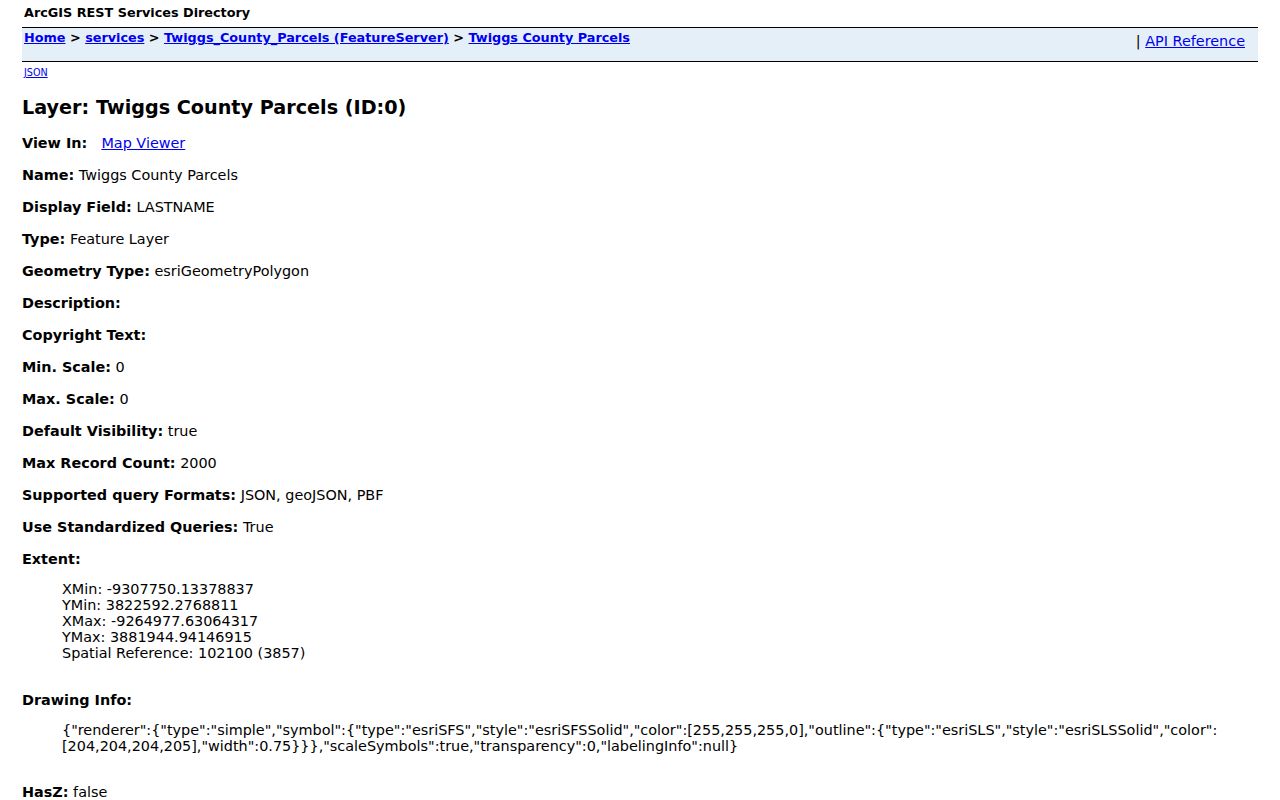
The layer view shows why the parcel key should be copied exactly before moving on to the deed index.
Twiggs Owner Strings Need Context
An owner field often holds more than a surname. One public sample reads "MAXWELL JANIE D ESTATE." Another lists two owners joined by an ampersand. Treat these strings as leads rather than reasons to shorten the property search. Use the exact spelling first. Then test initials, spacing, and entity suffixes in the deed records index.
An estate label can point toward Twiggs Probate Court records and a fiduciary deed. A company name can be run through the Georgia Corporations Division search to confirm its legal spelling. It can also confirm the registered agent. That corporate record does not prove land ownership. The recorded deed and matching legal description do.
Where Twiggs Ownership Is Recorded
Every Twiggs County ownership source has a narrow job. The assessor maintains the name tied to the tax parcel. The Clerk of Superior Court records deeds. The GIS map connects a parcel to its place. The state business registry helps interpret an entity name. Reading them together beats trusting a single owner field every time.
| Where ownership appears | What it gives | How current |
|---|---|---|
| qPublic assessment roll | Tax-roll owner tied to parcel | Annual cycle; exact refresh interval unpublished |
| GSCCCA deed index | Newest deed's grantee and recording reference | Confirm the Twiggs good-through date in the index |
| Public parcel layer | LASTNAME owner proxy and parcel polygon | August 2024 assessor data snapshot |
| Georgia business search | Entity name, status, and agent clues | Entity record only, not proof of title |
The owner of record is not necessarily an occupant. A mailing address may sit elsewhere. The accessible GIS data does not publish that mailing field. Never infer who lives at a site from the tax-roll name.
Confirm the Twiggs Property Owner
GSCCCA offers party, instrument, county, neighboring-county, and date controls. Search the current tax roll name as grantee first. Then open the newest likely result. Compare book and page or instrument number, execution and recording dates, and the legal description. An address match alone is weak. Older deeds may not give a modern street. They may instead describe a land lot, district, creek, road, or metes-and-bounds course.
The name-search screen displays a statewide range beginning in 1990. That is not a confirmed Twiggs-specific cutoff, nor a promise that every image is online. Karen F. Burke, Clerk of Superior Court, holds the local fallback at 425 Railroad Street N in Jeffersonville. She can direct a request by book/page or instrument reference. For present-owner detail after a recent sale, the Twiggs current owner record explains the roll-to-deed check. It does so without reconstructing the older chain of title.
Twiggs Ownership Terms in Plain English
A few plain terms keep the property records from being confused. They describe how a name appears. They do not settle any legal title question.
- Owner of record
- The person or entity named on the assessment roll as of its update.
- Grantee
- The party receiving the interest described in a recorded deed.
- Title
- The legal rights in land, which may require more proof than one public name field.
- Situs address
- The physical parcel location, distinct from an owner's mailing address.
These distinctions matter most for estates, trusts, joint owners, and companies. The public name can be correct and still need a second record. That second record explains who may act for the owner.
City Labels Can Mislead Ownership Searches
Danville and Allentown cross county boundaries. A city or ZIP label alone will not select the right assessor or Clerk. Place the parcel inside Twiggs County first. Use the parcel polygon and county boundary on the GIS map. If it falls across the line, search the neighboring county's deed records instead. The Twiggs city pages explain this local geography in more depth. See Danville property records and Allentown.
This check helps when a name search returns no deed. The failure may reflect the wrong county. It could also be a changed parcel or a different name form. The ownership information itself is not missing.
Twiggs Owners Can Watch New Filings
A free option worth setting up is the GSCCCA FANS property-fraud alert. The service sends a notice when a filing enters the system. It matches your name, address, or document category. Think of it as an early warning, nothing more. An alert cannot block a recording. It cannot vouch for the validity of a document. Nor can it take the place of reading the instrument itself.
When a notice arrives, treat it as a prompt. Contact the Twiggs Clerk and inspect the actual deed record before drawing conclusions. GSCCCA rolled the service out statewide in 2023 and reports broad eCertification use. Still, no automated match is perfect, so verify anything important against the recorded source.
Limits of a Twiggs Owner Lookup
An owner lookup answers one question well. It tells you who the owner of record is for a Twiggs County parcel. The answer comes from a dated tax roll or deed index. That is where its reach ends.
No result from a property search proves that someone actually lives at the parcel. It cannot resolve an unrecorded claim. It will not fix a surveyed boundary or substitute for a title opinion. Georgia confidentiality programs and redactions can also hide some personal address details. When legal reliance matters, rely on a certified instrument and qualified title help.
Use ownership records lawfully. A tax-roll name is not a title search, and ownership may rest in an estate, trust, or LLC. Never use owner details to stalk, harass, intimidate, or harm anyone.
For a purchase, estate matter, or boundary dispute in Twiggs County, keep the parcel number and the recording reference close at hand. Those stable keys hold up over time. They let the custodian pull the source record from property records even after a name changes or a street label is revised.