
Trace Twiggs County Former Owners
No single static list holds Twiggs County former owners. You rebuild them from transfers. The newest deed supplies the first grantor, and that grantor becomes the next earlier target. Every result must describe the same tract.
| Record stage | Known coverage | Access point | Ownership clue |
|---|---|---|---|
| GSCCCA name index | Displayed statewide from 1990 | Online party search | Grantor, grantee, dates, recording key |
| Deed books and images | Twiggs run must be confirmed | Superior Court Clerk | Legal description and transfer terms |
| Historic land index | 1807 to 1874 leads | Local genealogy finding aid | Grantees, estates, lots, districts |
| Historic maps | Town and 1867 district maps | Map finding aid | Old place and boundary context |
Start online for a modern transfer. When the chain predates the displayed index, or a name search fails, move to the Clerk and the older finding aids.
Twiggs Online Deeds Begin Later
The GSCCCA real-estate name search shows a statewide start of January 1, 1990. It displays no Twiggs-specific good-through date. No pre-1990 imaging run appears either. An empty result therefore proves nothing about whether a former owner or deed exists.
The official page offers party, instrument, county, neighboring-county, date, and result-count controls. Those controls help narrow a chain.
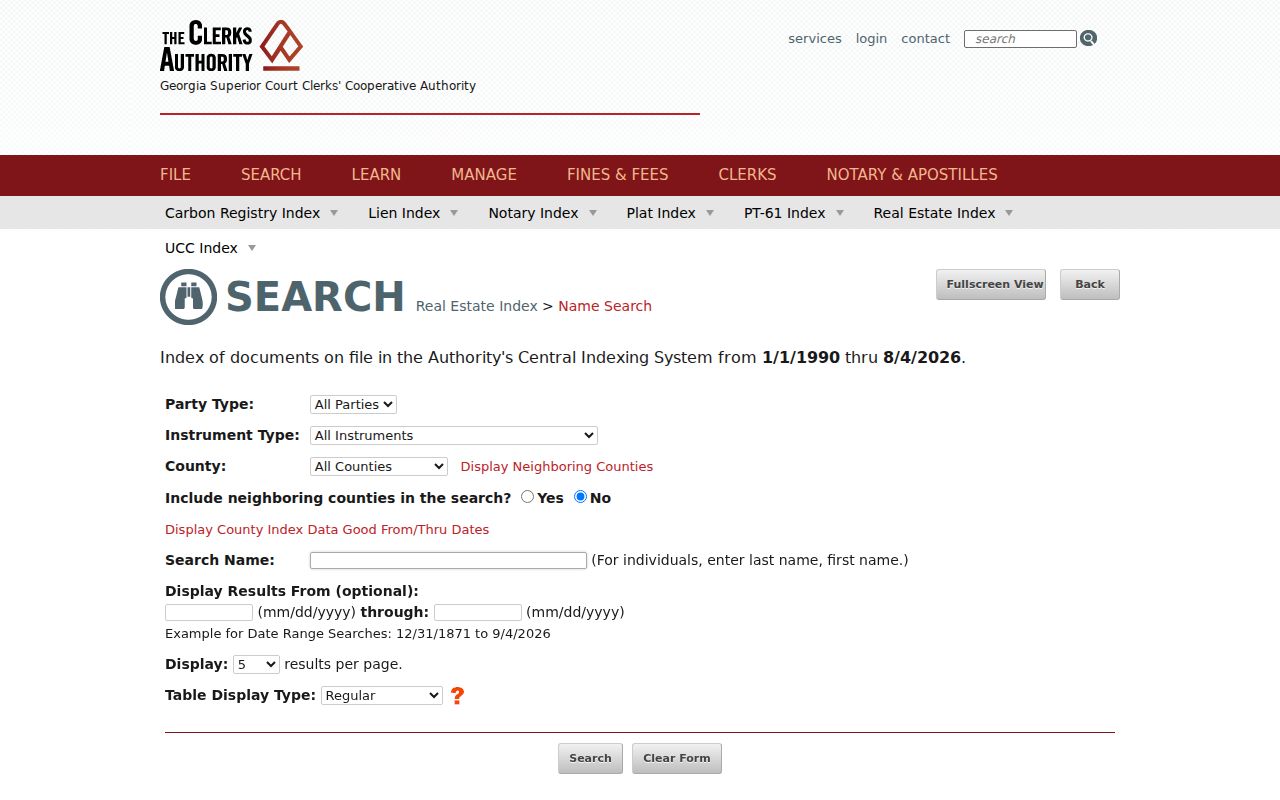
Every result reference should end at the deed image itself. Otherwise, request the full legal description from the Clerk.
Online does not mean complete. The screen starts at 1990; older Twiggs prior owners may be in deed books, maps, probate files, or historic indexes.
Reconstruct the Twiggs Chain Backward
Begin with a deed known to cover the subject parcel. From its grantor, work toward the earlier deeds that conveyed the same land.
- Find the current owner's purchase deed and note its grantor, date, and recording key.
- Search that grantor as a grantee in an earlier period, using initials and spelling variants.
- Confirm the earlier deed covers the same tract through the legal description.
- Repeat to the online boundary, then continue through Clerk-held deed books and indexes.
- Grantor / grantee
- The transferring party and receiving party named by the deed.
- Chain of title
- The linked sequence of transfers for one tract.
- Legal description
- The land description that outlasts many street and parcel-number changes.
- Reverse index
- A route that searches earlier grantees from each later grantor.
Book and page often beats a noisy name search. It targets one known record and can reveal the prior deed reference embedded inside.
The 1901 Twiggs Chain Break
Fire destroyed the old Jeffersonville courthouse on February 6, 1901, along with the records held there. The replacement courthouse followed in 1902 and 1903. That is a warning about survival. It is not permission to assume every earlier ownership fact is gone. Later deeds may recite earlier book references, while probate orders, tax-digest clues, plats, maps, newspapers, and cemetery records can rebuild context around a parcel. Mark every reconstructed link by source.
Twiggs District Names Find Older Owners
The historic Twiggs land index covers 1807 to 1874 grantee and estate leads. It lists land lots. It also lists districts 6, 7, and 23 through 28. The index reflects Baldwin, Twiggs, and Bibb county transitions. When a modern query misses a prior owner, search those older jurisdictions. Estate, plantation, and acreage names can work better than a current address. So can creek, road, railroad, and community names. Always verify a finding-aid entry against the original record.
Probate Explains Twiggs Past Transfers
A sale-to-sale chain can pause at a death. Search the deceased, the estate, the executor, or administrator. Check Twiggs Probate Court and the deed index. Petitions to sell, year's support awards, fiduciary deeds, and final orders can explain the transfer.
An ESTATE owner string is only a lead. It does not identify all heirs or prove the roll reflects a later deed. Compare the fiduciary's authority date, the deed date, the recording date, and the land description. The probate case explains authority; the recorded deed documents the land transfer itself.
Twiggs Names Change Across Deeds
Older Twiggs County indexes may shorten first names, use initials, preserve a former surname, or tuck an estate term into an odd corner of the entry. Search both spouses, trustees, and executors. Try common punctuation variants too. Two matching surnames are not automatically the same person.
Geographic evidence breaks ties. Land lot, district, acreage, road, creek, railroad, adjoining owner, and book references can separate same-name results. Former community names such as Dry Branch, Delzel, Elmwood or Fitzpatrick, Gallemore, Delphus, and Durham's Bluff may serve as stronger historical keys than any current postal label.
Parcel Changes Complicate Prior Owners
A split or merge can change everything. Today's land may carry a parcel number that never appeared in any older deed. Trace the legal description backward. Note whether each deed conveyed all or only part of the tract. Letter suffixes in current identifiers, such as the public DV01 001A sample, must stay intact. Historic plats and later deeds may show when a parent tract became smaller lots. That is why a backward chain should record acreage and legal calls. Names and dates alone are not enough.
Book and Page Stabilize Twiggs History
GSCCCA offers a direct book and page search for a known recording. A prior deed may cite an earlier book and page. Use that reference first. Then return to broad party-name results only if needed. A stable citation bypasses spelling shifts, joint-name order, and a crowded surname index.
Record both execution and recording dates when available. They describe different events and may not share a day. Note the instrument type and any prior-deed recital as well. No image may exist online. Give the Twiggs Clerk the exact citation in that case. Ask for the existing public record, not a new title search.
How Far Twiggs Ownership Goes
Twiggs County ownership can be traced far back. Online access and record survival are two different things. Karen F. Burke, Clerk of Superior Court, serves as the local recorder. Her office sits at 425 Railroad Street N in Jeffersonville. Her office holds the deepest record set. Staff can help with the public terminal, pull archived books, or retrieve an image. You just supply an exact book/page or instrument number. The Clerk can also confirm the index dates that apply to Twiggs County. That matters when you are working at the edge of what has been digitized.
For fleshing out names and places, old maps, library archives, census entries, cemetery records, and newspapers can all help. Anchor every step to a deed or probate record, though. Parcel splits and new parcel numbers add another layer. Matching an old holding to a current one takes land lots, district, acreage, adjoining-owner calls, and later references.
Use history records lawfully. Former-owner research supports house history, estate work, and property diligence. Never use it to track, harass, or harm a living person.
A reconstructed chain is not a title opinion. When you need formal proof of a Twiggs County transfer, the Twiggs deed records process explains how to obtain the actual instrument from the recorder.