
Compare Twiggs County Property Values
Three figures get mixed up constantly. The assessor's estimate serves the digest. Georgia generally places taxable real property at 40 percent of fair market value, and a deed's consideration reports what a transfer stated rather than a proven open-market sale.
| Value type | Meaning | Official record |
|---|---|---|
| Assessed value | Statutory share used in tax administration | Board of Assessors record |
| Fair market value | Assessor's estimate of full value for the tax year | Assessment notice or parcel card |
| Sale consideration | Amount reported with a recorded transfer | Deed or PT-61 data |
Exemptions change taxable treatment, not market value. A tax bill can move while the estimate holds steady. Bills, exemption applications, and appeals belong to separate tax administration, so a value comparison stops once each number is identified.
Georgia's Twiggs Assessment Ratio
Georgia law generally places taxable real property on the digest at 40 percent of fair market value. That level is an assessment ratio. It is not a sale discount. The ratio explains why an assessed value can sit far below a full market estimate for the same Twiggs County parcel.
Check the field label and tax year first. Never apply the ratio blindly to an unlabeled number pulled from a map layer.
Twiggs GIS Value Needs a Label
The public parcel dataset exposes a field named CURR_VAL. Its metadata does not say whether that field means fair market value. It also may not match assessed value or another total in every record. Treat it as a labeled GIS figure only. Verify the full assessment card before relying on it. Review the Twiggs sample parcel query to see the raw fields.
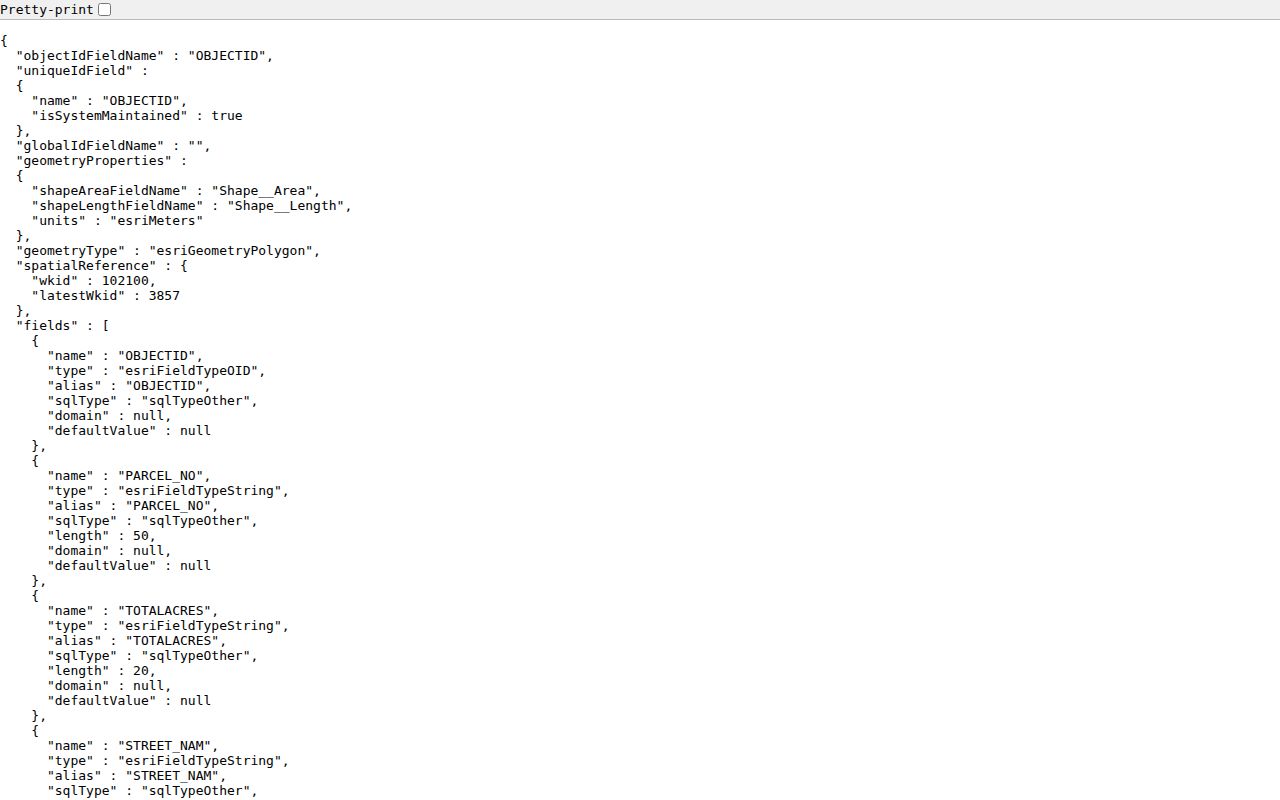
The sample's acreage and CURR_VAL totals demand confirmation first.
Estimate a Twiggs Property Value
Use the assessor record as your official starting point.
- Search the address or parcel in Twiggs qPublic.
- Read each value label and tax year; note separate land and improvement figures if displayed.
- Check the latest recorded deed or PT-61 information for sale consideration and transfer date.
- Compare only parcels with similar acreage, zoning, land use, and improvements.
- Assessed value
- The statutory portion used in property-tax administration.
- Market value
- The assessor's full-value estimate for the record year.
- Assessment ratio
- The relationship between assessed and fair market value.
- Consideration
- The amount reported with a transfer, which is not always a market sale price.
- Reassessment
- A new review or update of the value on the assessment roll.
A challenge page on qPublic blocks nothing. Call the Board of Assessors at (478) 945-3663 and request the labeled values for the exact parcel and tax year.
Twiggs Values Follow an Annual Cycle
Twiggs assessment notices go out in late May or early June, with a 45-day appeal window from the notice date. That calendar tells owners when a decision arrives. It does not set a real-time refresh interval for qPublic.
Compare values from one tax year only. A deed recorded today, an older GIS layer, and a later assessment notice can each describe the same parcel at a different point in time. Mixing years invites false conclusions.
Twiggs Sale Consideration Is Different
GSCCCA systems include deed and PT-61 routes that may supply consideration or sales-price data. Not every figure is market evidence. Family transfers, estate deeds, partial-interest transfers, and non-arm's-length deals can report numbers that say nothing about open-market value.
Match the legal description. Match the transfer type too. Then label the figure as recorded consideration unless the source clearly supports a more specific term.
Acreage Changes Twiggs Comparisons
The sample parcel data includes tracts of 427 acres, 2 acres, and 6.09 acres along Highway 80. The spread tells the story. Owner strings and value figures differ just as sharply, which is why a large estate tract cannot be compared with a small residential parcel on price or value alone.
Twiggs land use varies widely. Kaolin, forestry, farming, industrial parks, and conditional-use activity create very different classes. Zoning and acreage should narrow the set first.
No Published Twiggs Value Trend
Twiggs County publishes no official revaluation trend series that supports a countywide percentage claim. The current digest notice and Board of Assessors schedule show an active assessment process. Neither proves how one parcel changed.
Build a time series from parcel-year records and notices. Record the field label and year for every point. Do not infer a trend from a few GIS samples or mix an assessed number with a market estimate.
Exemptions Change Taxable Treatment
Homestead, age and income, current-use, and conservation programs appear among Twiggs assessment forms. An exemption can change taxable treatment. The parcel's fair market value need not drop at all. Keep the exemption field apart from market and assessed figures when comparing records.
The qPublic forms route and Board of Assessors office hold current application details. Eligibility and appeals belong with the tax record. This comparison only explains the divergence.
Land and Improvements Need Separation
A parcel card may separate land from building or improvement value. That split explains the total. It also aids comparisons. qPublic does not publish the exact live Twiggs labels, so ask the assessor for the labeled breakdown rather than inventing a field name.
Vacant acreage, farm or forest land, an industrial tract, and an improved home belong in separate comparison sets. Zoning and acreage narrow them first. So do the legal description and structures.
What Twiggs Property Value Cannot Prove
An assessor's property value is a mass-appraisal figure for tax administration. It proves no sale price. It cannot settle title or establish a surveyed boundary. It also cannot replace inspection of a building. The GIS value is narrower still. Until its field meaning is confirmed on the parcel card, treat it cautiously.
Value is not price. A Twiggs County assessed value is for taxation and is not what the property must sell for. It is not an appraisal.
Estimates and assessments have their limits. For the bill itself, along with exemptions and the appeal path, the Twiggs property tax record is the right tool, so keep those procedures separate from reading deed records or appraisal figures for value.